
Henry Cowell (1897–1965)
Hymn and Fuguing Tune No. 10 (1955)
In his eighteen Hymn and Fuguing Tunes the 20th century iconoclast Henry Cowell reached back to one of the earliest bonafide American composers, William Billings. Born in 1746, he was apparently an ungainly chap who paid scant attention to his personal grooming and who died in extreme poverty at the age of 53.
Early America placed a high premium on music education. To that end, educators and composers developed shape-note notation, a system by which the steps of the scale are indicated by differently-shaped notes. It’s like a visual version of moveable-do solfège, which assigns various syllabus to the steps of the scale as an aid to learning melodies. A collection of shape-note hymns called Southern Harmony inspired Cowell’s modern gloss in which he channels Billings’ sturdy style while providing his own newly-composed tunes.
Cowell tells us that No. 10, for oboe and strings, was inspired by “Southern Revival meetings in which popular minstrel show rhythms were turned to religious purposes.” The reserved initial melody with its lovely harmonization eventually gives way to the ‘fuguing’ treatment in which melodic lines imitate each other, the whole radiating gentle cheer and optimism.
John Adams (b. 1947)
Violin Concerto (1993)
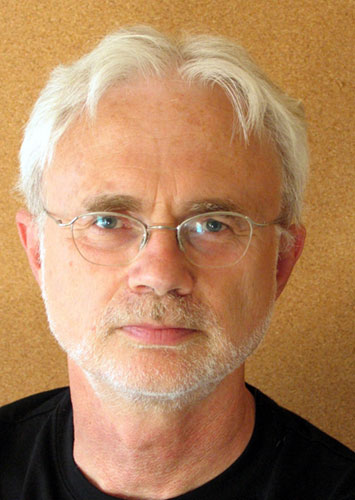
John Adams has been happily exploring the broad spectrum of music throughout his career. Originally trained as a clarinetist, he played in marching bands and orchestras alike, conducted Harvard’s student-run Bach Society Orchestra, absorbed rock music à la Jimi Hendrix and Bob Dylan, and studied composition. His all-embracing musical ethos was on full display during his tenure in the 1970s at the San Francisco Conservatory of Music, where I was his student in several classes and ensembles.
Another memorable presence on the SF Conservatory faculty in those days was a new violinist in the San Francisco Symphony, Jorja Fleezanis, who eventually went on to the Minnesota Orchestra as their first female concertmaster. It was Jorja’s tireless energy that powered a triple commission from the Minnesota Orchestra, London Symphony Orchestra, and the New York City Ballet for John Adams’s Violin Concerto, which has become an integral repertory item ever since Jorja played the premiere in 1994.
The Adams concerto both honors and departs from traditions amassed over several centuries of violin concertos. For example, the solo part is often extremely high in the violin’s register à la Beethoven—a strategy that defends against the soloist being drowned out by the orchestra. But orchestra and soloist do not share materials, a situation almost unheard of in earlier concertos. Instead, they co-exist, each tending to their own bailiwicks, such as the first movement’s constant rising-tendril orchestral figurations that are complemented by a nearly nonstop “hyper-melody” (Adams’s own term) in the solo violin, which plays for an astonishing 91% of the movement’s duration.
The second movement provides the orchestra with a cyclically repetitive melodic figure, a time-honored practice known as either chaconne or passacaglia. (Don’t believe anybody who claims to know the precise difference between the two.) The violin floats above, thus the movement title Chaconne: Body through which the dream flows. The concluding Toccare (i.e., ‘touch’ piece in Baroque terminology, typically for virtuoso keyboard) is an unrestrained jamboree, a country fiddler let loose to go at it with maximum bravura.
Ludwig van Beethoven (1770–1827)
Symphony No. 2 in D Major, Op. 36 (1803)
Concert programs were a lot longer in Beethoven’s day than in our own. Consider Beethoven’s program for an elephantine affair on April 5, 1803 that included the First Symphony, the Third Piano Concerto, and the oratorio Christ on the Mount of Olives in addition to his brand-new Symphony No. 2 in D Major, Op. 36. Apparently rehearsals were troubled and some pieces were dropped at the last minute. The concert doesn’t seem to have gone all that well. But the new symphony did receive generally favorable notices in the press, save the typical protest that the work was “too long and some passages overly artificial.”
The overall affect of the Second Symphony is of heroism, optimism, and robust good cheer. That’s particularly impressive given Beethoven’s chaotic state of mind during the work’s gestation, a period that was amongst the most wrenching of his life. His hearing had been steadily deteriorating for some time, as tinnitus—a ringing in his ears—was blotting out all other sounds. He had tried any number of remedies and had visited any number of healers, some of them quacks, to no avail. In despair, he had taken a lease on a lodging in the nearby country town of Heiligenstadt, where in October 1802 he wrote a letter to his brothers, undelivered and found amongst his papers after his death. In this so-called ‘Heiligenstadt Testament’ he acknowledged his affliction and hinted at thoughts of suicide, but counterbalanced that with a steely determination to meet this calamity head on and surmount his despair.
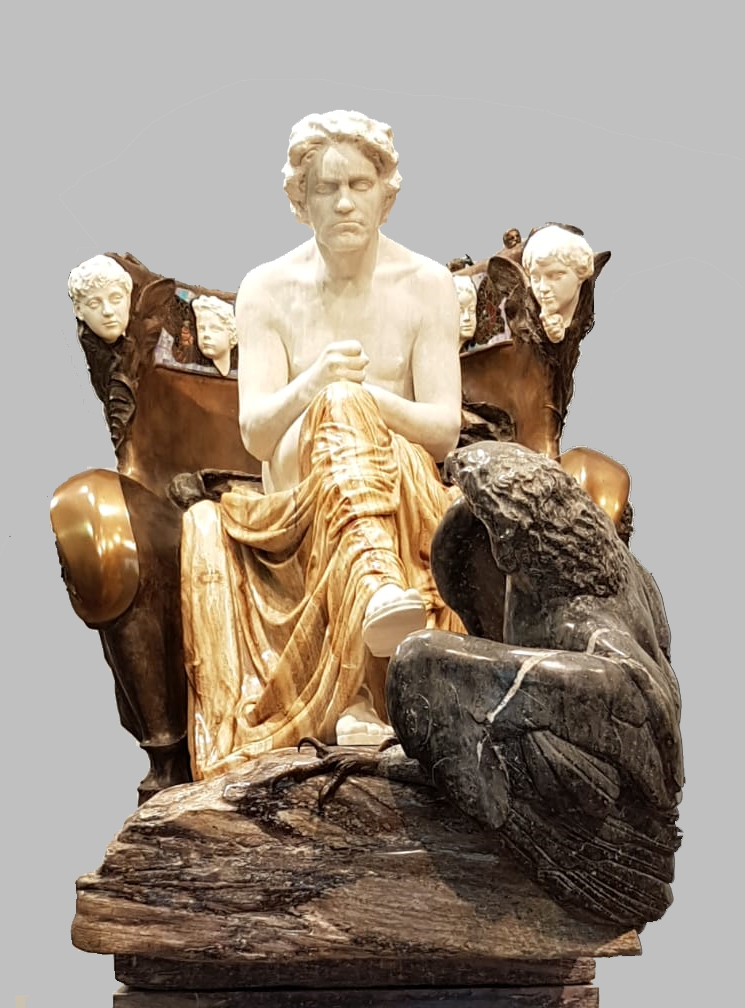
The Second Symphony marks a resolute break with the late-Classical gestalt of the First Symphony. Compared to the late symphonies of Haydn and Mozart it is vaster in scale and broader in scope; it is audacious and adventuresome, gutsy and fearless, personal and self-revealing. Nothing like its moonlit, confessional slow movement had been attempted before in the essentially public arena of the symphony, and surely no previous symphonic finale had ever teemed with such coiled energy and near-manic glee. Listening to the work nowadays, with the revolutionary impact of the Eroica or the psychological arc of the Fifth in our collective consciousness, it may be a bit difficult to recognize the Second for the barnburner that it was. But it was no mere predecessor to the landmarks still to come. “Of a depth, power, and artistic knowledge like very few,” wrote one contemporary critic. The Second expressed not only the restless new spirit of its age, but also the indomitable will of a composer who refused to retreat in the face of personal disaster.
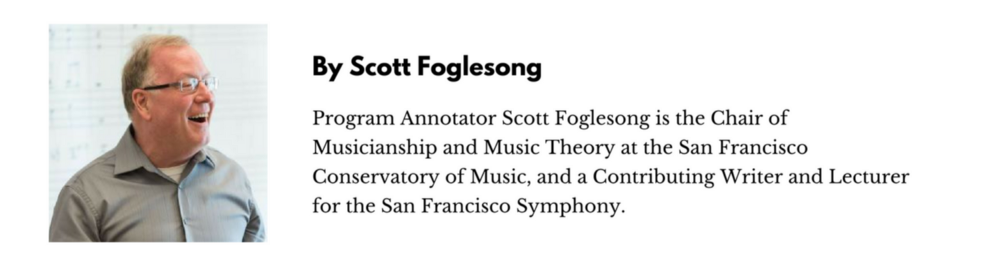
Program Annotator Scott Foglesong is the Chair of Musicianship and Music Theory at the San Francisco Conservatory of Music, and a Contributing Writer and Lecturer for the San Francisco Symphony. He also leads the California Symphony’s ground-breaking music education course for adults Fresh Look: The Symphony Exposed.
The 26-27 Season continues with BEETHOVEN’S SECOND on Saturday, March 13 at 7:30 p.m. and Sunday, March 14 at 4 p.m. at the Lesher Center for the Arts in Walnut Creek. Single tickets start at $50 and at $25 for students 25 and under, and include a free 30-minute pre-concert talk starting one hour before the performance. Buy tickets online or call or visit the Lesher Center Ticket Office at 925.943.7469, Wed – Sun, 12:00 noon to 6:00 p.m.