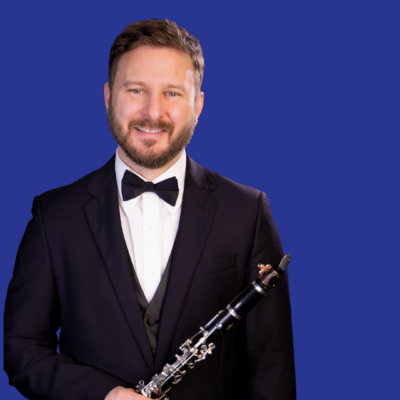

From an unexpected introduction to the clarinet to performing with orchestras across the country, Cory Tiffin has built a career around making music with others. Ahead of his performance of Copland’s Clarinet Concerto in California Symphony’s FROM TCHAIKOVKSY TO COPLAND, we caught up with Cory to talk about his musical journey, what he loves about performing, and why he believes it’s never too late to try something new.
How did you first get started playing the clarinet?
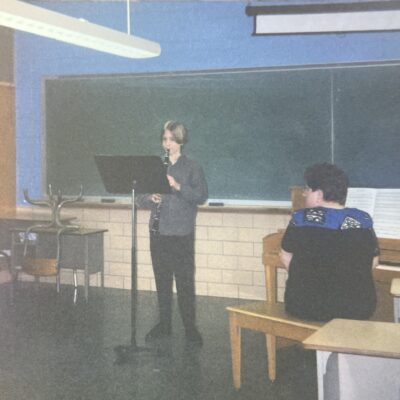
I started playing clarinet when I was about 10 years old. It was pretty typical. The band director came around and demonstrated all the instruments, and then we had an opportunity to try them and pick our favorites.
Like many of the boys, I wanted to play drums or saxophone. But the school required a year of piano to play percussion, and I couldn’t get a sound out of the saxophone. My first choice was actually oboe. They told us how difficult it was, and I picked it up and started playing notes without much trouble. I went home and told my mom I wanted to play the oboe, and she said, “That thing sounds like a damn duck!”
So, I ended up with the clarinet. And I’m glad I did.
At first, I was just another kid in band. But after a couple of years, I started showing an aptitude for it. My high school band director was a clarinetist, and when she heard me play in seventh grade, she encouraged me to take private lessons. My playing really took off after that.
By the time I was 13, I had decided I wanted to be a clarinetist. I started practicing every day and taking it seriously.
When did you realize you could pursue music professionally?
I think it happened gradually. When I was 15, I won a local concerto competition with the Illinois Valley Symphony, and my parents bought me my first professional clarinet, a Buffet Festival.
By then, I was very serious about playing. I eventually went to DePaul University in Chicago because I wanted to study with musicians from the Chicago Symphony Orchestra and Lyric Opera.
I knew I wanted to be an orchestral clarinetist, and I wanted to surround myself with people who were performing at that level. The level of playing at DePaul was incredibly high, and being around those musicians pushed me to become better.
You’ve performed with orchestras throughout the country. How did you build that career?
In my early and mid-20s, I became frustrated that I wasn’t getting enough playing work in Chicago. The work I was getting often didn’t pay very well, and I wanted to figure out how to make a living playing the clarinet.
So I started traveling.
Eventually, I was performing with orchestras throughout the Midwest and beyond. I held positions with the Illinois Symphony and Green Bay Symphony, performed regularly with the Elgin Symphony and Kalamazoo Symphony, and eventually became a member of the Chicago Philharmonic.
I’ve also been principal clarinet of the Las Vegas Philharmonic since 2011, which has been an important part of my professional life.
When we moved to California, I immediately started playing more regularly with orchestras throughout the Bay Area and Central Valley, including the Modesto, Stockton, and Oakland symphonies.
The Bay Area has a fairly tight-knit and unique orchestral community. People sometimes call it the “Freeway Philharmonic” because there are so many orchestras and so many musicians traveling between them. Everybody seems to know each other, and people carpool to rehearsals and concerts. I love how friendly and supportive everyone is with one another.
What do you enjoy most about playing in an orchestra?
As a woodwind player, we get to switch seamlessly between playing solo lines and being a part of the texture. In general, I love blending with all the different instruments and combinations of instruments and hearing the different timbres we create together.
There are certainly exciting moments when you have a big solo or a particularly challenging passage. But some of my favorite experiences are the moments when you’re blending your sound with other musicians.
It could be a beautiful woodwind trio, or something like the opening of Rachmaninoff’s Second Piano Concerto, where the clarinet is playing in unison with the entire cello section.
There’s something extraordinary about blending all those sounds together in real time.
You’ll be performing Copland’s Clarinet Concerto with California Symphony. What makes this piece special to you, and what should audiences listen for?
This is my first time ever performing the Copland Concerto, even though it’s a piece I’ve known about since high school. Along with the Mozart Concerto, I’d argue it is the best concerto written for our instrument. It showcases what the clarinet can do and wastes no time at all. It’s a relatively short concerto, but it’s packed with beauty, intensity, and joy.
I love how American the piece is—not in a nationalistic way, but in a manner that incorporates some of the music from around the Americas. It’s immediately evident that Copland employs his pastoral style that has become so synonymous with Americana, and he was clearly influenced by jazz as well, but one can also hear flashes of other distinctly American styles—like Brazilian choros, for example.
I’ve wanted a chance to play this piece for over two decades now, and I’m so excited to share this experience with the California Symphony community.
What do you like most about living in the San Francisco Bay Area?
One of my favorite things is being able to go hiking.
I’ve hiked Mount Diablo from the bottom to the top, which is a pretty intense hike.
The landscape here is incredible, and the weather makes it possible to spend so much time outdoors.
That’s something I’ve really enjoyed about living in California.
What’s something you used to believe that you don’t believe anymore?
That it’s too late.
I don’t believe that it’s too late to change something about your life.
That could be something as simple as your daily routine, or it could be something much bigger, like changing your career, recovering from an injury, or deciding to pursue orchestral auditions seriously.
I used to tell myself that I was getting too old for something or that I’d missed my opportunity.
But I think 99 times out of 100, that’s simply not true. We tell ourselves those things out of fear.
It’s not too late. The present moment is what we have; believe in yourself and spend it wisely!
Cory Tiffin performs Aaron Copland’s Clarinet Concerto at FROM TCHAIKOVSKY TO COPLAND, Saturday, November 7 at 7:30 PM and Sunday, November 8 at 4 PM at the Lesher Center for the Arts in Walnut Creek. Tickets are $50 to $110 and $25 for students 25 and under, and include a free 30-minute pre-concert talk starting one hour before the performance. Buy tickets online or call or visit the Lesher Center Ticket Office at (925)943-7469, Wednesdays through Sundays, 12:00PM to 6:00PM.