Harmoniemusik in Vienna
Music for wind band (harmoniemusik) was long a Viennese mainstay. In a land filled with music-loving aristocrats who couldn’t afford a resident full-time orchestra, a wind ensemble (harmonie), typically made up of pairs of oboes, clarinets, horns, and bassoons, provided a handy source for the ‘table music’ (tafelmusik) that accompanied dinners, garden parties, and the like. In fact, Emperor Joseph himself maintained a first-class harmonie, drawn from the principal wind players of the Imperial opera.
Music Director Donato Cabrera tells us that “the narrative and focus of this concert is the importance and predominance of the harmoniemusik (wind ensemble) in Viennese music, and I’ve chosen music from the classical, romantic, and 20th century to tell this story.”
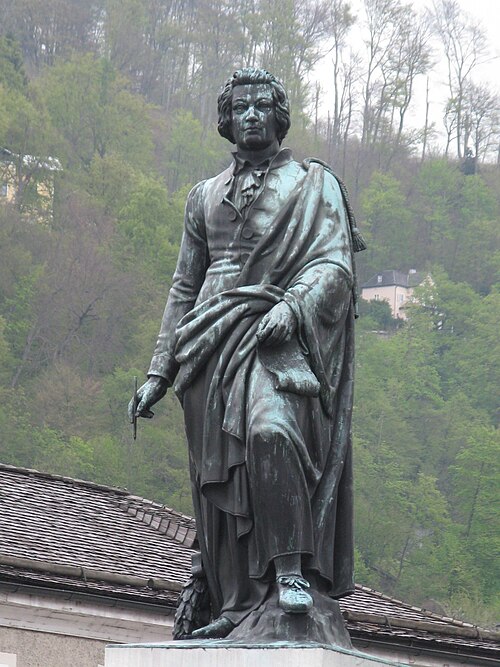
Wolfgang Amadeus Mozart (1756–1791)
Excerpts from Don Giovanni (1788, arr. 1803)
“Well, I am up to the eyes in work, for by Sunday week I have to arrange my opera for wind-instruments. If I don’t, someone will anticipate me and secure the profits” wrote Mozart to his father Leopold. The opera was The Abduction from the Seraglio, and like all composers of successful operas, Mozart wanted the extra cash to be had from a harmoniemusik suite drawn from the opera’s arias and instrumental numbers.
Mozart’s 1788 Don Giovanni even incorporates a harmonie during the finale’s banquet scene; the group plays selections from various recent hit operas, including Mozart’s own The Marriage of Figaro. However, Mozart didn’t give us a harmoniemusik suite for Don Giovanni, and that’s where Josef Tribensee’s 1803 arrangement for wind band – no singing – comes in handy. This performance features five selections in their modern updates by Andreas Tarkmann, beginning with the Overture, then skipping to Leporello’s quick-talking slither out of a jam as he is mistaken for the dastardly Don by some extremely annoyed people. Then fast-forward to the end, with three numbers: the Don and Leporello invite the ‘stone guest’ to dinner, the animated statue carts the Don off to the underworld, and then the Finale ultimo, the original of which is often omitted in stage productions.
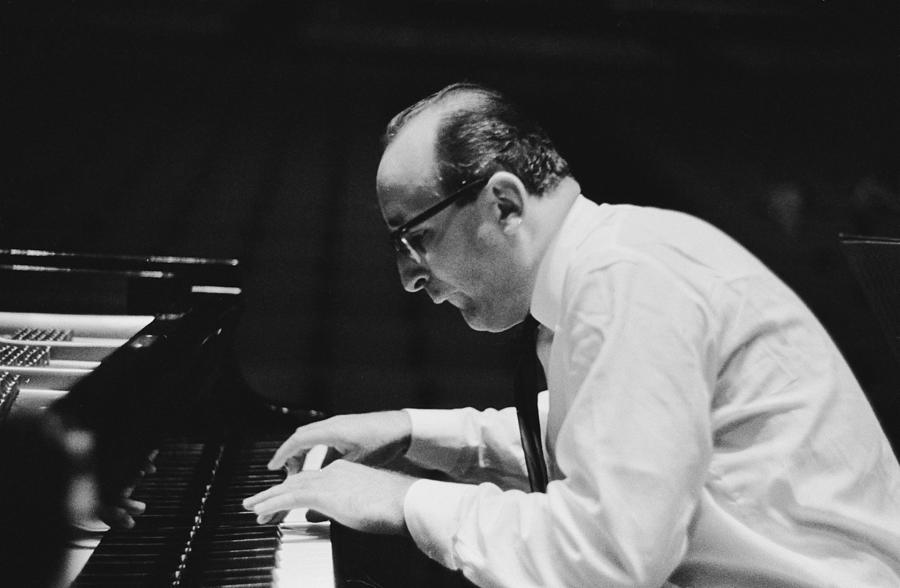
Friedrich Gulda (1930–2000)
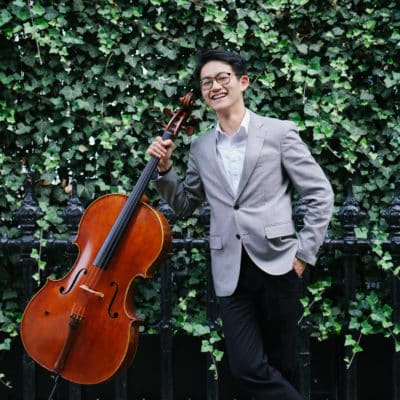
Cello Concerto (1980)
“I don’t want to fall into the routine of the modern concert pianist’s life, nor do I want to ride the cheap triumphs of the Baroque bandwagon.” Not much chance of that. Friedrich Gulda was sui generis, an artist who took eclecticism to the bleeding edge and then some, a pianist who played some recitals in the nude, a guy who faked his own death to get a sense of his post-mortem publicity, a superlative interpreter of the Viennese classics à la Beethoven and Mozart, a jazz collaborator with the likes of Chick Corea, the acclaimed teacher of such worthies as Claudio Abbado and Martha Argerich, and a fascinating – albeit quirky – composer.
As Gulda’s 1980 Cello Concerto commences, unprepared listeners might experience a mental gulp: oh, sheesh, what have I gotten myself into? This is no traditional concerto. It’s like something out of an episode of Miami Vice. But then the brassy jazz combo gives way to what is essentially a classic harmonie – wind instruments joining the cello in beguiling lyricism. Then the combo resumes all that urban bling. Further movements explore the dichotomy of new (brass) versus old (wind), in idioms suggesting Mozart, Schubert, Lalo Shifrin, folk dances, and maybe even Jerome Kern. An extended central cello cadenza, some of it improvised, stands at the heart of the work. The finale breaks free of all restraint: circus music? Keystone Kops? Looney Tunes? Whatever you call it, the thing’s utterly exhilarating.
Not your usual cello concerto, in other words. But then again, Friedrich Gulda wasn’t your usual musician.
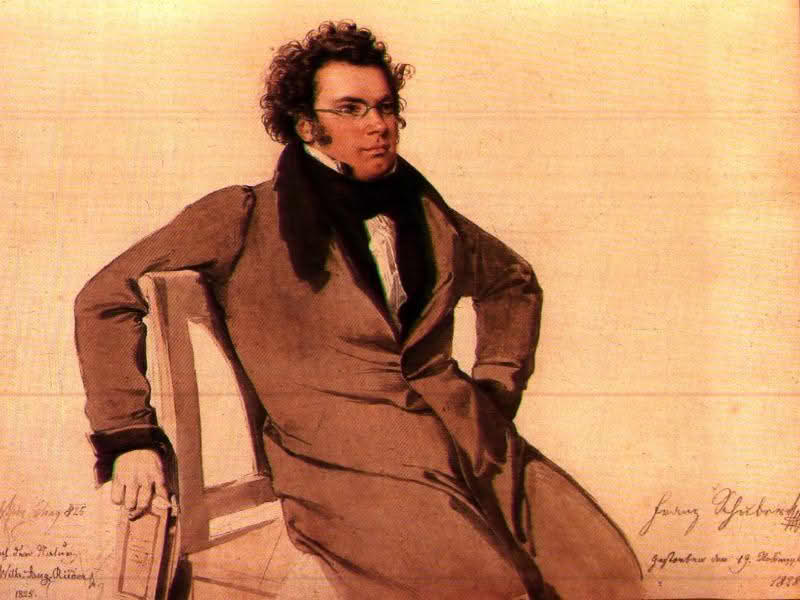
Franz Schubert (1797–1828)
Symphony No. 9 in C Major, D. 944 (1825)
When Franz Schubert was busy composing – which was most of the time – he could be exasperatingly distant, even to his closest friends. In 1824 the painter Moritz von Schwind noted with wry amusement that “if you go to see him during the day, he says, ‘Hello, how are you?—Good’ and goes on writing.” Schubert’s focused industry made him prolific, but it has frustrated his biographers, who must attempt détente with an artist who dwelled largely in the privacy of his own mind. So Schubert remains elusive, even after two centuries. If an aura of mystery is an essential component of our ideal of the Romantic artist, then Schubert – appealing, ambiguous, and ultimately enigmatic – embodies that ideal to perfection.
The mystery extends to Schubert’s final (more or less) symphony. For a good long time scholars considered it to be a product of that last hyper-productive year of 1828, as he raced against his deteriorating health. But it seems that he started it around 1825, quite probably during one of his very few vacations, on tour with friend and colleague Johann Michael Vogl. Schubert was reported as having begun a C Major symphony while in Gmunden and Bad Gastein. That symphony, which would have been his seventh, was once dubbed the “Gasteiner” and considered lost until analysis of the manuscript paper of the Ninth Symphony pointed to an 1825 origin, rather than 1826 as once thought. Thus Schubert’s mightiest and most noble symphony turns out to have been a product, at least in part, of that happy summer, while the erstwhile “Gasteiner” symphony has floated away to the musicological bardo. First performed in 1838, the Ninth took a good long while to achieve repertory status.
In his last compositions Schubert tended to go wide, and that’s very much in evidence with this broadly-conceived symphony that contrasts gentle rusticism with noble expansiveness, whimsy with melancholy, and sunlight with shadow. Maestro Cabrera has noted that the wind band takes a leading role, as the main themes are typically introduced by the winds before the strings. As a result, the orchestra will take a slightly different seating than usual, with the wind instruments up front and center, acknowledging the principal roles they play in this cherished monument of early Romanticism.
Program Annotator Scott Foglesong is the Chair of Musicianship and Music Theory at the San Francisco Conservatory of Music, and a Contributing Writer and Lecturer for the San Francisco Symphony. He also leads the California Symphony’s ground-breaking music education course for adults Fresh Look: The Symphony Exposed.
The 25-26 Season continues with SCHUBERT IN VIENNA, on Saturday, January 24 at 7:30 p.m. and Sunday, January 25 at 4 p.m. at the Lesher Center for the Arts in Walnut Creek. Single tickets start at $50 and at $25 for students 25 and under, and include a free 30-minute pre-concert talk starting one hour before the performance. Buy tickets online or call or visit the Lesher Center Ticket Office at 925.943.7469, Wed – Sun, 12:00 noon to 6:00 p.m.